


Since July 2019, Mekong Region Land Governance (MRLG) project with the group of social organisations called Forestland Alliance (FORLAND) coordinated by the Center for Indigenous Knowledge Research and Development (CIRD) implement the Vietnam’s workstream for customary tenure recognition through support to the implementation of the Forest Law 2017. This work group aims for the two domains of changes. Firstly, regarding policy change, legal documents and implementation guidelines under the Forestry Law that facilitate the recognition of rights of poor and vulnerable households, individuals and communities over forest lands are promulgated fully by 2022. Secondly, regarding practice change, to promote access and control over forest and forestry land of local communities, the work group pilots improved processes of forestry land and forest allocation to local communities and develops appropriate co-management and value-chain based community forestry enterprises models.

Quang Binh province is where one of the pilot models is being implemented, overall the project is supporting four pilot models in Hoa Binh, Quang Binh and Dak Lak provinces that aim to provide experience and understanding about community forest allocation and management by local communities through community forest management to influence local and national policies on forests. The pilot models specifically address policies on forest and land allocation to local communities and community-based forest management, which are expected to ensure the access and control over land and forest by local communities.
Quang Binh province is heavily forested with forest that cover over 613,000 hectares, in which the forest category of ‘Special Use Forest’ or commonly understood as ‘conservation forests’ accounts for 150,000 hectares. Because it is one of the largest areas of the tropical forest and the biodiversity of flora and fauna in Vietnam, the area was classified as ‘Special Use Forests.’ However, some areas are being protected and conserved by local people without legal recognition by the government. This happened recently after a period of community-led conservation efforts by villagers in the Thach Hoa, Dong Hoa, Thuan Hoa and Son Hoa communes successfully protected the local Ha Tinh Langur population.
The Ha Tinh Langur (delacour’s langur) is an endemic species of old world monkey, which is found only on the border of Vietnam and Laos in the Phong Nha Ke Bang National Park of Quang Binh province, Vietnam and in the Hin Nam No National Protected Area of Laos, according to Dr. Nguyen Hai Ha from Vietnam Forestry University. They are also classified by the IUCN as an endangered species. From the record of Dao Van Tuyen, the species reside at Thanh Hoa, Nghe An, Ha Tinh, Quang Binh, Quang Tri and Thua Thien Hue. After the recognition of Ha Tinh Langur in forests within four communes; Thach Hoa, Dong Hoa, Son Hoa and Thuan Hoa, under MRLG project, CIRD together with Tuyen Hoa district people committee coordinated with the provincial forest protection department to support local communities in managing and protecting the langur.
One afternoon in 2012, after planting trees on the mountain, Mr. Nguyen Thanh Tu, a member of the Thach Hoa commune, heard the sound of the langur. He recognised its call as he was trained by the Convention on International Trade of Endangered Species of Wild Fauna and Flora (CITES) to do this. Mr. Tu is the leader of the community-led conservation crew. He developed his love for nature and wildlife since the young age. “I love nature and wild animals. I attended some trainings on endangered and extinct species. This is the reason why I stood up for this species protection” said Mr. Tu.
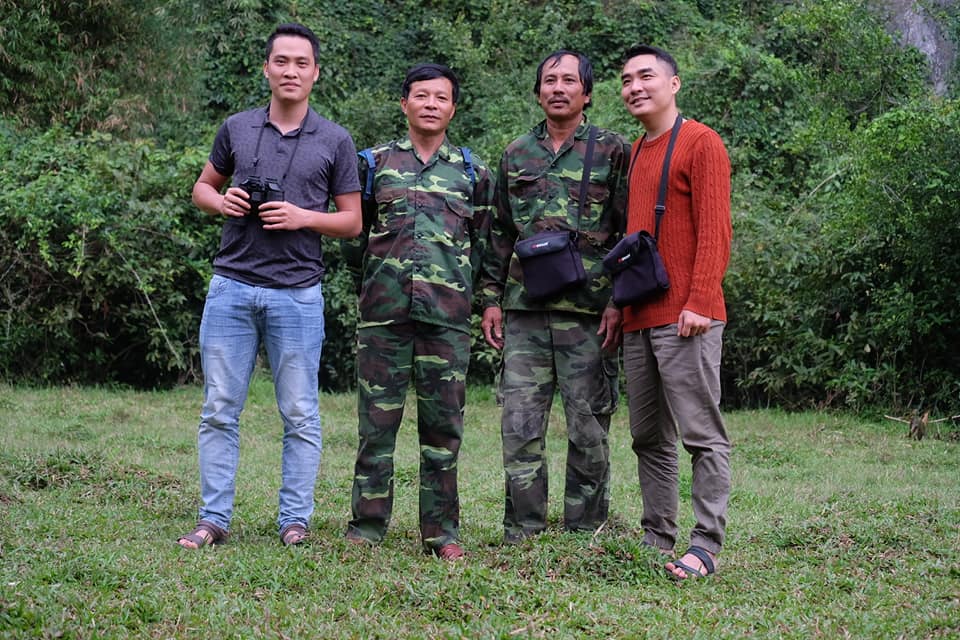
The voluntary group was formed in 2012, the year Mr. Nguyen Thanh Tu retired as a border guard. After 8 years of their voluntary conservation efforts, the number of langurs has increased to 156 individuals. Although, they do not have the accurate calculation tools, they were able to identify 11 troops with around 10 langurs per troop. The biggest troop consists of 18 langurs and the smallest troop is 9.
“From individual interest in wildlife conservation, we group up to protect our valuable natural resources like langur and the forest. At the early stage it was challenged as we didn’t receive positive response from the locals. They said we prevented them from benefiting from the natural resources like hunting and encroaching effecting their income. We were insult (sic) many times, but we keep continuing our aim to protect the natural resources.” Mr. Tu said with determination.
After much hard work, the local people are starting to recognise their efforts. They gradually realise the importance of forest and langur protection.
“It took 8 years to raise awareness of the local people. At first, they didn’t fully understand what we have been doing so we have to educate them about our actions. Now we receive fully support from them” said Mr. Tu. “We have been protecting our natural resources without any government support, but we hope that the government will see our efforts and recognise our contribution” the voluntary group leader, Mr. Tu continued.
This MRLG pilot project, implemented by CIRD, is attempting to find legal avenues and pathways for the Local communities to have rights to their community conserved area, within the ‘special-use forest’ area recognised. Currently there is no legal and financial support to the voluntary group and as well as no regulation to allow the group operation to adhere to current laws. The Quang Binh Provincial People’s Committee is preparing an economic and technical feasibility study for establishing the species and habitat of langur in 4 communes, Tuyen Hoa district Quang Binh province. The local authority is considering how to protect the langur in parallel with eco-tourism and relics conservation, then to partly support the voluntary group financially.
“To develop a community-led conservation network is an advanced and strategic approach. Local community participation in natural resources conservation is crucial as it contributes to the quality of conservation, awareness raising and benefit sharing within the local community. Traditionally, we manage and protect the forest based on official administration. The Tuyen Hoa commune conservation model is a good example of Quang Binh province” Dr. Nguyen Hai Ha, Vietnam Forestry University concluded.


