Phase III of the Mekong Region Land Governance project closed in December 2025. This page will remain active for a limited time, but all publication materials and toolkits have been transferred to a permanent home on the Land Portal site here.

Ấn phẩm

Truy cập kho tài nguyên và nghiên cứu của MRLG để đưa ra quyết định sáng suốt và khám phá kho kiến ​​thức phong phú nhằm thúc đẩy thay đổi tích cực và tác động đáng kể.

Guiding Principles Towards Responsible Agricultural Investment in Lao PDR

This discussion note summarizes the findings and recommendations of a multi-stakeholder initiative and study tour conducted in Southern Laos, to study the social and environmental practices of two large scale companies holding large scale concessions. This Learning and Alliance Group included government institutions (Investment Promotion Department (IPD) and Department of Agricultural Land Management (DALAM), CSOs linked with the Land Issue Working Group, and Private sector investors. The main r…
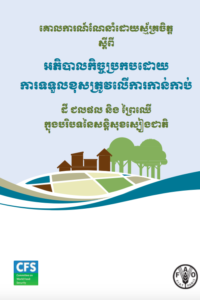
Khmer Version of FAO’s Voluntary Guidelines on the Responsible Governance of Tenure (VGGT)

AO published its Voluntary Guidelines on the Responsible Governance of Tenure (VGGT) of Land, Fisheries and Forests in the Context of National Food Security in 2012. The purpose of these guidelines is to serve as reference and to provide guidance to improve the governance of tenure of land, fisheries and forest with the overarching goal of achieving food security for all and to support the progressive realization of the right to adequate food in the context of national food security. The guideli…

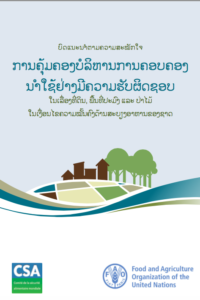
Lao Version of FAO’s Voluntary Guidelines on the Responsible Governance of Tenure (VGGT)

FAO published its Voluntary Guidelines on the Responsible Governance of Tenure (VGGT) of Land, Fisheries and Forests in the Context of National Food Security in 2012. The purpose of these guidelines is to serve as reference and to provide guidance to improve the governance of tenure of land, fisheries and forest with the overarching goal of achieving food security for all and to support the progressive realization of the right to adequate food in the context of national food security. The guidel…

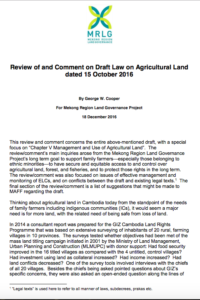
Review of and Comment on Draft Law on Agricultural Land Dated 15 October 2016

As the Ministry of Agriculture, Forestry, Fisheries (MAFF) aimed to finalize in the end of 2016 the draft law on agricultural lands that is currently in 6th draft, MRLG, together with other partners, has supported the NGO Forum on Cambodia to mobilize representatives of farmer organizations and CSOs so that they could voice their concerns over the draft law directly to MAFF. In close cooperation with MAFF, a 2-day national consultation workshop was held on 19-20 December 2016 in Phnom Penh. As a…

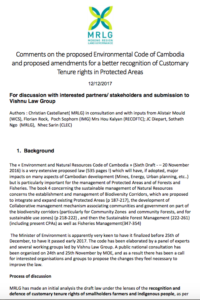
Comments on the Proposed Environmental Code of Cambodia (V6) and Proposed Amendments for a Better Recognition of Customary Tenure Rights in Protected Areas

The « Environment and Natural Resources Code of Cambodia » (Sixth Draft – – 20 November 2016) is a very extensive proposed law (535 pages !) which will have, if adopted, major impacts on many aspects of Cambodian development (Mines, Energy, Urban planning, etc..) but is particularly important for the management of Protected Areas and of Forests and Fisheries. The code has been elaborated by a panel of experts and several working groups led by Vishnu Law Group. A public national consultation has…

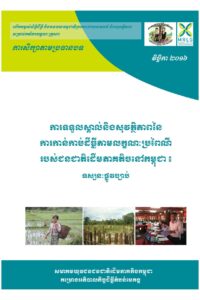
The Recognition and Security of Customary Tenure of Indigenous Peoples in Cambodia: a Legal Perspective (in Khmer)

This short thematic study challenges the assumption that the legal framework to recognize and protect indigenous peoples’ (IP) customary lands is adequate and that the challenge lies in its implementation. With support from MRLG, a core group of IP NGOs of the Cambodia Indigenous Peoples Alliance (CIPA) held a series of seminars to scrutinize this legal framework, identify gaps and make recommendations for a revision of the supporting legal framework. The thematic study documents this joint refl…

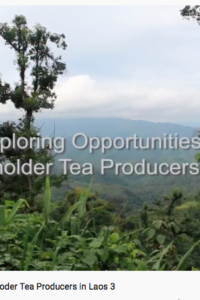
Exploring Opportunities for Smallholder Tea Producers in Laos

This short video examines an initiative by Earth Systems to develop a tea sector dialogue platform that brings together key stakeholders in the value chain to jointly examine challenges and opportunities for the development of a more equitable and sustainable tea sector in Laos. The video highlights the outcomes and lessons from a tea stakeholder workshop held in Phongsaly province, northern Laos, in July 2016.

The Recognition of Customary Tenure in Myanmar

This thematic study presents an analysis of customary tenure arrangements in Myanmar and identifies key challenges and opportunities for strengthening the recognition of customary tenure in the country. Drawing on examples from various regions and states, the study highlights key features of customary tenure systems, which vary depending on history, geography, resource base, ethnicity and social organization. It shows that customary tenure includes both communal land and private plots claimed by…

The Recognition and Security of Customary Tenure of Indigenous Peoples in Cambodia: a Legal Perspective

This short thematic study challenges the assumption that the legal framework to recognize and protect indigenous peoples’ (IP) customary lands is adequate and that the challenge lies in its implementation. With support from MRLG, a core group of IP NGOs of the Cambodia Indigenous Peoples Alliance (CIPA) held a series of seminars to scrutinize this legal framework, identify gaps and make recommendations for a revision of the supporting legal framework. The thematic study documents this joint refl…

Experience of Agribusiness Investment in Lao PDR

This document presents the experiences of two investors, Stora Enso Laos and Outspan Bolovens Limited, who have invested in agribusiness plantations (eucalyptus and coffee respectively) in the south of Lao PDR. It discusses the lessons learned on four key topics related to responsible investment: (1) land acquisition, (2) compensation and benefit sharing, (3) community engagement, and (4) grievance mechanisms. They are the result of a week-long multi-stakeholder engagement and dialogue, involvin…

They Will Need Land! The Current Land Tenure Situation and Future Land Allocation Needs of Smallholder Farmers in Cambodia

The question addressed by this study is: if the present trends continue, how much land will be needed to ensure the livelihoods of family farmers in Cambodia in the next 20 years? The study synthesises available data on land use, land tenure and demographic trends to answer to this question, and will serve as input to the policy debate organized by MRLG in Cambodia. In Cambodia, the majority of the population is still composed of smallholder family farmers. 54% of the total labour force is emplo…

They Will Need Land! The Current Land Tenure Situation and Future Land Allocation Needs of smallholder Farmers in Cambodia – Briefing Note

This brief is a summary of the original study: They Will Need Land! The Current Land Tenure Situation and Future Land Allocation Needs of smallholder Farmers in Cambodia by Jean-Christophe Diepart The question addressed by this study is: if the present trends continue, how much land will be needed to ensure the livelihoods of family farmers in Cambodia in the next 20 years? The study synthesises available data on land use, land tenure and demographic trends to answer to this question, and will…

Scroll to Top